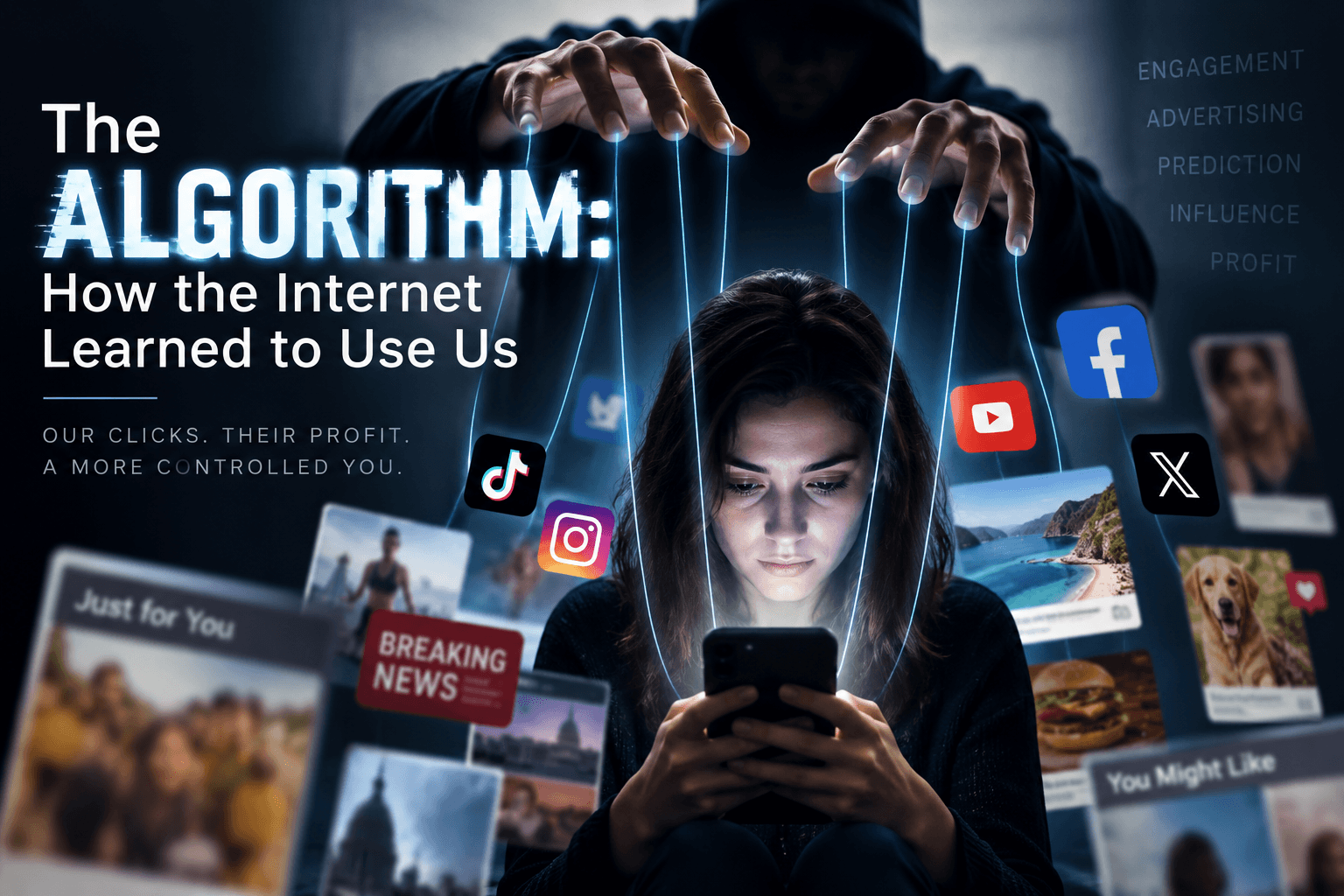
There was a time when we used the Internet.
We opened a browser, typed in an address, searched for something we wanted, read what we came to read, and moved on.
Today, the relationship is very different.
Now the Internet watches us back.
It learns what we click. It notices what we ignore. It measures how long we stop on a video, which headlines make us pause, which posts make us angry, what we buy, what we search for, who we follow, and what keeps us scrolling long after we intended to stop.
Then it uses that information to decide what to show us next.
We usually call this system simply:
The Algorithm.
But “the algorithm” is not really one thing. It is a collection of recommendation systems, advertising platforms, behavioral models, ranking systems, and artificial intelligence tools working behind the scenes to answer a deceptively simple question:
What can we show this person next that will keep them engaged?
That question has quietly changed the Internet.
And it may be changing us with it.
The Internet Is Learning You
Every time we interact with a digital platform, we leave behind clues.
You watch a video about remodeling a kitchen.
Then another.
You pause on a video showing new countertops.
You search for flooring.
You click on an advertisement for a couch.
You read a discussion about home renovation.
Individually, none of those actions seems particularly significant.
Together, they create a pattern.
The system learns:
This person is interested in remodeling.
So it shows you more.
Before long, Facebook, YouTube, Instagram, TikTok, Google, and other platforms may appear to be filled with remodeling content.
It can begin to feel like everyone is remodeling their house.
But they are not.
You are simply seeing more of what the system believes will interest you.
That distinction is important.
You are not necessarily seeing the Internet.
You are seeing your Internet.
Two People Can Live in Two Different Internets
Two people can sit next to each other, open the same social media platform, and experience completely different worlds.
One person’s feed might contain:
- Recipes
- Vacation destinations
- Dogs
- Home improvement
- Technology
Another person’s feed might contain:
- Political outrage
- Crime stories
- Conspiracy theories
- Economic fear
- Cultural conflict
Both people may believe they are simply observing what is happening in the world.
But neither person is seeing an objective representation of the world.
They are seeing a version of reality that has been selected specifically for them.
And that selection is based largely on their previous behavior.
This creates something far more powerful than traditional media ever could.
Television used to broadcast the same program to millions of people.
Newspapers printed the same front page for everyone.
Radio stations played the same songs for everyone listening.
Modern digital platforms can effectively create a different information environment for every individual user.
Millions of people can receive millions of slightly different versions of reality.
The Algorithm Does Not Need to Understand You
One of the most interesting things about recommendation systems is that they do not necessarily need to understand why you behave the way you do.
They only need to predict what you will do next.
They may learn that you tend to click videos about technology.
Then they may discover that you spend longer watching videos about artificial intelligence.
Then they may discover that you spend even longer watching videos suggesting that AI could eliminate jobs.
Then they may discover that you are especially likely to click videos with dramatic titles.
So your feed may gradually evolve.
- “AI Is Changing the Workplace.”
- “These Jobs Could Disappear Because of AI.”
- “Millions of Jobs May Soon Be Replaced by AI.”
- “Nobody Is Telling You the Truth About What AI Companies Are Planning.”
Each step is slightly more dramatic.
Slightly more emotional.
Slightly more difficult to ignore.
Not necessarily because someone intentionally decided to radicalize the viewer.
But because the system discovered something important:
The stronger message produced more engagement.
Engagement Is the Real Currency
Most social media platforms are not primarily optimized to make us informed.
They are not necessarily optimized to make us happier.
They are not optimized to make us wiser.
They are optimized around measurable behavior:
- Clicks
- Comments
- Shares
- Watch time
- Purchases
- Return visits
- Time spent on the platform
And unfortunately, the things that produce the strongest engagement are not always the things that are best for us.
Human beings are particularly responsive to certain emotional triggers.
- Fear gets our attention.
- Anger makes us react.
- Conflict makes us choose sides.
- Validation makes us feel good.
- Novelty keeps us curious.
- Uncertainty keeps us checking.
- Confirmation makes us comfortable.
- Outrage makes us talk.
The algorithm learns which of these work best on each individual.
Not humanity in general.
You.
The Feedback Loop
This creates what may be one of the most important features of the modern Internet:
The behavioral feedback loop.
You click something because it caught your attention.
The system interprets your click as interest.
It shows you more.
You click again because more of that subject is now appearing.
The system becomes more confident that this is what you want.
It shows you even more.
Eventually, something that started as mild curiosity can dominate your feed.
This can happen with almost anything:
- Politics
- Health
- Investing
- Artificial intelligence
- Crime
- Celebrity gossip
- Dieting
- Religion
- Parenting
- Conspiracy theories
- Even hobbies
Someone may begin by watching one video about electric vehicles and eventually find themselves surrounded by content arguing that electric vehicles are either going to save civilization or destroy it.
The middle often disappears.
Because moderation is usually less engaging than certainty.
Why Everything Becomes Extreme
Imagine two headlines.
“Researchers Discuss Possible Economic Effects of Artificial Intelligence.”
And:
“AI Is About to Destroy the Economy and Nobody Is Ready.”
Which one are more people likely to click?
The second.
The algorithm notices.
Then content creators notice what the algorithm rewards.
So they make more dramatic headlines.
Those headlines receive more engagement.
The algorithm distributes them farther.
Other creators copy them.
Soon the entire information environment begins drifting toward exaggeration.
This is not always because everyone involved is dishonest.
It is often because the system rewards intensity.
The result is an Internet where the loudest version of an idea frequently travels farther than the most accurate version.
The Slot Machine in Your Pocket
There is another psychological principle that social media uses extremely well.
Psychologists call it variable reinforcement.
Casinos have understood this concept for generations.
A slot machine does not reward you every time.
That would actually become boring.
Instead, rewards arrive unpredictably.
- Pull the lever. Nothing.
- Pull again. Nothing.
- Again. Small win.
- Again. Nothing.
- Again. Bigger win.
That uncertainty keeps people playing.
Now consider scrolling through social media.
- Scroll. Nothing interesting.
- Scroll. Advertisement.
- Scroll. Funny video.
- Scroll. Political post.
- Scroll. Photo from an old friend.
- Scroll. Something fascinating.
- Scroll. Something outrageous.
- Scroll. Something you absolutely have to send to someone.
The reward is unpredictable.
So we keep scrolling.
We are always searching for the next interesting thing.
The next laugh.
The next surprise.
The next outrage.
The next little hit of novelty.
And the device providing that experience is sitting in our pocket all day.
Notifications Are Part of the System Too
Notifications operate using the same basic psychology.
Sometimes the notification is meaningless.
Someone liked a comment.
An app has an update.
A company is offering a discount.
But sometimes the notification matters.
A friend messaged you.
Someone commented on your photo.
A family member sent something.
Because we do not know which kind of notification it will be, we check.
Over time, we become trained.
- Buzz. Check phone.
- Sound. Check phone.
- Red badge. Check phone.
The remarkable part is that eventually the notification may not even be necessary.
We begin checking automatically.
- Standing in line
- Waiting for an elevator
- Sitting at a stoplight
- Watching television
- Eating dinner
We reach for the phone without consciously deciding to.
At some point, we stop using the technology intentionally.
The technology begins shaping our behavior.
Your Attention Is Valuable
There is an old saying about free Internet services:
“If you are not paying for the product, you are the product.”
That is not entirely wrong, but it is incomplete.
A more accurate version might be:
Your attention, your behavior, and your ability to be influenced are part of the product.
Attention has economic value.
The longer a platform holds your attention, the more opportunities it has to show advertisements.
The more the platform knows about you, the better it can target those advertisements.
The better the targeting becomes, the more valuable the advertising becomes.
So platforms have an enormous financial incentive to become better at predicting human behavior.
And they have become very good at it.
Advertising Has Changed Completely
Advertising used to be relatively simple.
A television commercial aired during a program.
Everyone watching saw the same advertisement.
A billboard showed the same message to everyone driving past it.
A newspaper advertisement appeared exactly the same to every reader.
Digital advertising changed that.
Today, two people may visit the same website and see completely different advertisements.
One person might see an advertisement for a truck.
Another might see retirement planning.
Another might see a vacation.
Another might see software.
Another might see political messaging.
The advertisements are selected based on thousands of possible signals, including:
- Age
- Location
- Search history
- Browsing behavior
- Purchasing behavior
- Interests
- Device usage
- Content engagement
- Predictive models
Advertising is no longer simply about finding an audience.
It is increasingly about finding the exact message most likely to influence a specific person.
From Personalization to Prediction
Personalization sounds friendly.
Netflix recommends a movie you might like.
Spotify recommends a song.
Amazon recommends a product.
YouTube recommends a video.
There is real value in that.
Recommendation systems have helped people discover music, books, restaurants, products, ideas, and communities they never would have found otherwise.
The problem begins when personalization evolves into prediction.
The system no longer simply asks:
What does this person like?
It begins asking:
What is this person likely to do next?
- Will they click?
- Will they purchase?
- Will they subscribe?
- Will they keep watching?
- Will they share?
- Will they become angry?
- Will they come back tomorrow?
Prediction is incredibly valuable.
Because once you can reliably predict someone’s behavior, the next logical step is attempting to influence it.
From Prediction to Persuasion
This is where artificial intelligence makes the future particularly interesting.
Imagine a system that learns:
- This person responds strongly to fear.
- Another responds to humor.
- Another responds to authority.
- Another responds to social approval.
- Another responds to financial incentives.
- Another responds to outrage.
- Another responds to stories.
The persuasive message no longer needs to be the same for everyone.
It can be tailored.
Not just by demographic.
Not just by location.
But potentially by psychological response.
One person receives:
“Protect your family’s future.”
Another receives:
“Don’t miss this opportunity.”
Another receives:
“Everyone is already doing this.”
Another receives:
“Experts say you should act now.”
Same product.
Different persuasion.
Artificial intelligence makes creating thousands or millions of variations extremely easy.
That changes advertising.
It changes marketing.
It changes politics.
It changes public relations.
It changes fundraising.
And it may eventually change how ideas spread through society.
The Most Dangerous Part Is That It Feels Natural
Very few people open social media thinking:
“I am about to enter a carefully engineered behavioral environment designed to maximize my engagement.”
We simply open the app.
Everything feels normal.
The videos appear.
The posts appear.
The advertisements appear.
The recommendations appear.
But the experience has been:
- Selected
- Ranked
- Filtered
- Predicted
- Optimized
- Tested
- Adjusted
Constantly.
You are participating in an enormous behavioral experiment every time you use many modern digital platforms.
Different headlines can be tested.
Different thumbnails.
Different recommendations.
Different notification times.
Different advertisement placements.
Different video lengths.
Different wording.
The system watches what people respond to and adjusts accordingly.
Usually automatically.
The Algorithm Does Not Have to Be Evil
It is tempting to imagine a group of people sitting in a room deciding how to manipulate society.
Reality is usually much less dramatic.
The algorithm does not need malicious intent.
It only needs a poorly chosen goal.
Imagine telling an incredibly powerful machine:
Keep people engaged.
The machine learns that outrage increases engagement.
So it shows more outrage.
Fear increases engagement.
More fear.
Conflict increases engagement.
More conflict.
Extreme opinions generate comments.
More extreme opinions.
None of this requires the machine to hate anyone.
It is simply optimizing the goal we gave it.
That may be the most important lesson of all.
A system does not need bad intentions to create bad outcomes. It only needs the wrong incentives.
So Who Is Really in Control?
The Internet is not going away.
Social media is not going away.
Recommendation systems are not going away.
Artificial intelligence certainly is not going away.
And none of these technologies are inherently bad.
The question is what we want them optimizing for.
- Engagement?
- Revenue?
- Truth?
- Education?
- Well-being?
- Discovery?
- Community?
The answer matters enormously.
Because the systems deciding what billions of people see every day now have extraordinary influence.
They influence what we talk about.
What we worry about.
What we buy.
What we believe is popular.
What we believe is dangerous.
What we believe everyone else believes.
And sometimes, what we eventually believe ourselves.
Taking Back a Little Control
We may never completely escape algorithmic influence, but simply understanding how the system works gives us an advantage.
We can become more intentional.
- Ask why something appeared in your feed.
- Pause before clicking the most dramatic headline.
- Search for opposing viewpoints deliberately.
- Follow people outside your normal information bubble.
- Turn off unnecessary notifications.
- Spend less time consuming whatever the feed selects and more time actively searching for information.
And perhaps most importantly, remember this:
Engagement is not the same as importance.
Something appearing repeatedly in your feed does not necessarily mean it is happening everywhere.
Something going viral does not necessarily mean it is true.
Something making you angry does not necessarily deserve your attention.
And something the algorithm wants you to see is not necessarily something you need to see.
The Question We Should Be Asking
For years, people have asked:
Is technology becoming too powerful?
That may not be the most useful question anymore.
Technology already has enormous power.
Perhaps the better question is:
Who gets to decide what that power is optimizing for?
Because the algorithm is no longer simply helping us navigate the Internet.
The Internet is studying us.
Predicting us.
Adapting to us.
And increasingly, learning how to influence us.
We created machines to help us find what we wanted.
Then those machines learned what kept us watching.
The next question is whether we remain the ones making the decisions, or whether, little by little, the algorithm begins making them for us.
“`