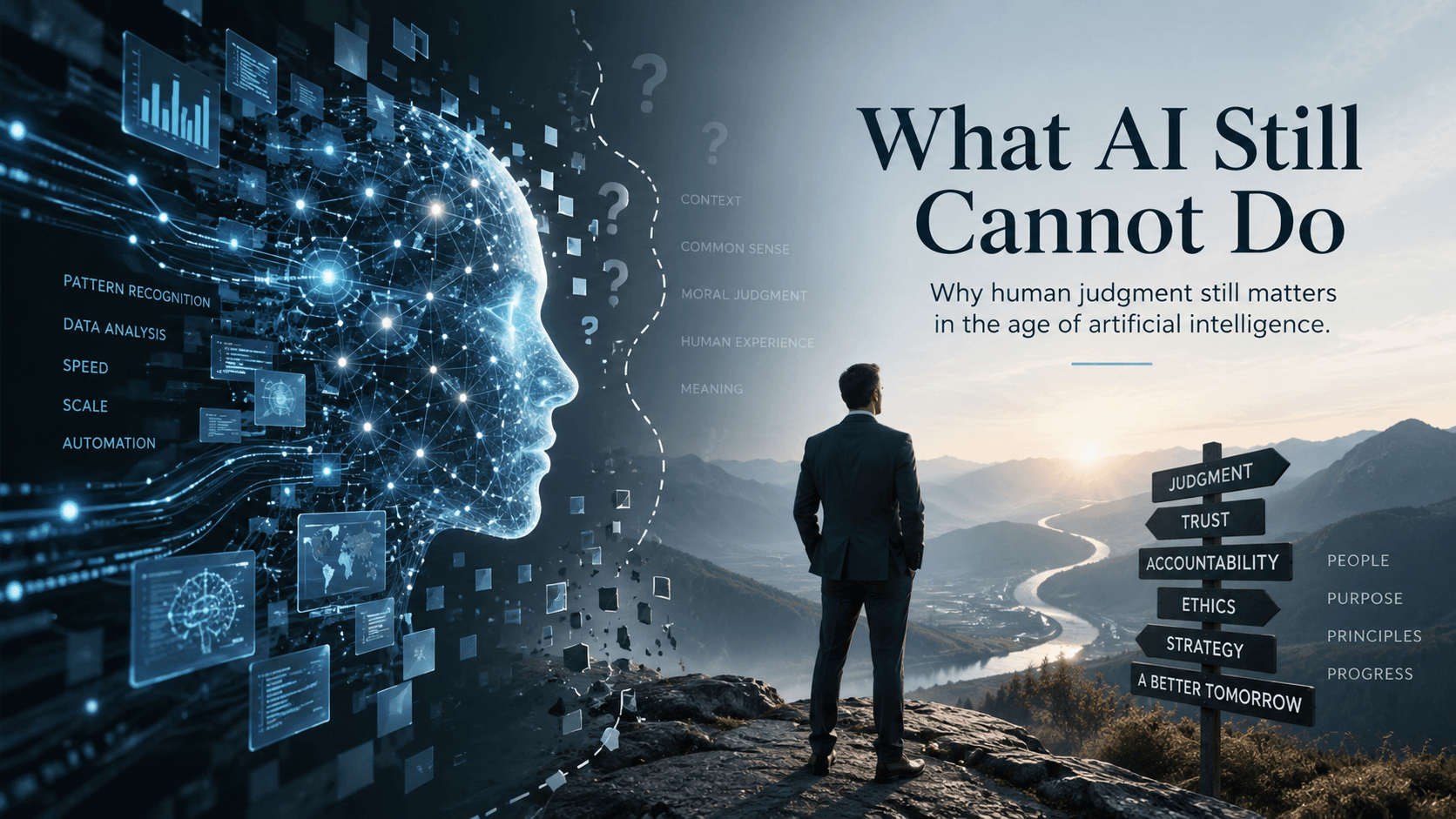
Artificial intelligence can write, analyze, summarize, code, generate images, answer questions, and process information at a scale that would have seemed impossible only a few years ago.
That capability is why so much of the conversation around AI focuses on what it can do.
But there is another question that matters just as much:
What can AI not do?
Understanding those limits is becoming increasingly important for businesses, leaders, employees, and anyone trying to decide where AI fits into the way they work.
AI Cannot Guarantee the Truth
One of the most important limitations of AI is also one of the easiest to overlook.
AI can be wrong.
More importantly, it can be wrong while sounding completely confident.
Modern AI systems are extremely good at producing plausible answers. That does not mean those answers are always accurate.
This is why verification remains critical, especially when AI is being used for legal, financial, medical, technical, operational, or strategic decisions.
AI can help find the answer. A person still needs to determine whether the answer is correct.
AI Cannot Replace Human Judgment
AI can analyze enormous amounts of information, compare options, identify patterns, and make recommendations.
What it cannot do is assume responsibility for the decision.
There is an important difference between saying:
“Here are the three most likely options.”
and saying:
“This is the decision we should make.”
Businesses still need people who understand the organization, the customer, the risks, the culture, and the consequences.
AI can support judgment. It should not automatically replace it.
AI Does Not Experience the World
AI can describe emotions.
It can recognize emotional language.
It can even respond in ways that appear empathetic.
But it does not experience those emotions.
It has never been frustrated by a customer. It has never worried about making payroll. It has never had to explain a difficult decision to an employee. It has never spent twenty years building relationships with clients.
Those experiences matter.
Human beings bring context to decisions that does not exist simply because a system has access to more data.
AI Does Not Have Values
AI can discuss ethics, values, priorities, and tradeoffs.
But AI does not have its own values.
Someone still has to decide what matters.
- Should a company optimize for profit?
- Customer satisfaction?
- Employee retention?
- Speed?
- Quality?
- Risk reduction?
- Long-term growth?
Those are human choices.
AI is very good at helping optimize toward a goal. Humans still have to choose the goal.
AI Cannot Know What It Cannot Access
Artificial intelligence can seem almost unlimited because it can answer questions about such a wide range of subjects.
But every AI system still operates within information boundaries.
It may not know what happened in a private meeting. It may not understand undocumented processes inside a company. It may not have access to current financial information, customer records, internal systems, or organizational history.
This is particularly important in business.
An AI system that does not understand how your company actually operates may give you a perfectly reasonable answer that is completely wrong for your organization.
Context matters.
AI Cannot Reliably Predict the Future
AI can identify patterns.
It can model scenarios.
It can calculate probabilities.
It can identify risks that humans might miss.
But prediction is not certainty.
- Markets change.
- Customers behave unexpectedly.
- Competitors make decisions.
- Technology evolves.
- Regulations change.
- People change their minds.
AI can help businesses prepare for multiple possibilities, but it cannot eliminate uncertainty.
AI Cannot Take Accountability
This may eventually become one of the most important distinctions between people and artificial intelligence.
AI can make a recommendation.
AI can generate an answer.
AI can perform an action.
But when something goes wrong, someone still has to be responsible.
A business cannot simply say, “The AI decided.”
Organizations need clear ownership over decisions made with AI.
Human accountability does not disappear because software participated in the process.
AI Cannot Automatically Understand Your Business
This is one of the areas where businesses often make mistakes.
They purchase an AI tool and expect it to immediately understand their organization.
But AI does not automatically know:
- How your employees work
- What your customers expect
- Why certain processes exist
- Which systems contain important information
- Where operational bottlenecks occur
- Which business rules are undocumented
- What makes your company different from competitors
The better the context, data, and systems surrounding AI, the more useful AI becomes.
That is why successful AI implementation is usually less about finding the newest AI tool and more about preparing the business to use AI effectively.
AI Cannot Replace Trust
Business is still built on relationships.
Customers hire people they trust. Employees follow leaders they believe in. Partners work together because relationships develop over time.
AI can help draft an email, prepare a presentation, analyze a conversation, or research a customer.
But it cannot replace the credibility that comes from consistently delivering on commitments.
Technology can support relationships. It cannot manufacture genuine trust.
The Bigger Question Is Not Whether AI Will Replace People
The more useful question is:
What should people stop doing because AI can do it better, and what should people spend more time doing because AI cannot?
AI is particularly good at:
- Processing information
- Recognizing patterns
- Generating first drafts
- Automating repetitive work
- Searching large amounts of data
- Summarizing information
- Creating variations
- Supporting analysis
Humans remain especially important for:
- Judgment
- Leadership
- Accountability
- Relationships
- Creativity with purpose
- Strategy
- Ethics
- Context
- Deciding what actually matters
The Future Is Probably Not Humans Versus AI
The most successful organizations will not be the ones that try to replace everyone with artificial intelligence.
They will be the organizations that understand where AI is strong and where humans remain essential.
The goal should not be to remove people from the process.
The goal should be to remove unnecessary work from people.
That allows employees to spend more time solving problems, serving customers, developing ideas, building relationships, and making better decisions.
AI is very good at doing work.
Humans are still responsible for deciding what work should be done, why it matters, and whether the result is actually good.
As AI becomes more capable, that distinction may become more important, not less.
The real competitive advantage may not come from using more AI. It may come from understanding exactly where AI should stop and human judgment should begin.