

Imagine asking your AI assistant to review your recent customer emails, identify outstanding projects, check your company calendar and prepare a summary of what needs your attention today.
Instead of manually gathering information from several applications, you could make a single request.
This is where Model Context Protocol, commonly referred to as MCP, comes into play.
MCP is changing how artificial intelligence interacts with the software, information and processes businesses rely on every day. It helps move AI beyond answering questions and generating content toward becoming a more useful part of everyday business operations.
Understanding MCP could help you uncover opportunities to save time, improve productivity and get more value from the technology your business already uses.
What is Model Context Protocol?
Model Context Protocol is an open standard that provides a common way for AI applications to interact with external software, tools and data sources.
Originally introduced by Anthropic in November 2024, MCP has attracted support from major technology companies and a growing community of developers.
Think of MCP as a universal adapter for artificial intelligence.
USB allows different electronic devices to communicate using a common connection standard. MCP provides a similar concept for AI applications that need to communicate with business software and information systems.
Rather than manually copying information into an AI application, an MCP connection can allow that application to request authorized information directly from another system.
Depending on the capabilities and permissions provided, AI may also be able to perform specific actions within that system.
MCP is not an AI model, a chatbot or a replacement for your existing software. It is a communication standard that helps these technologies work together.
You can learn more about the standard through the official Model Context Protocol website.
How does MCP work?
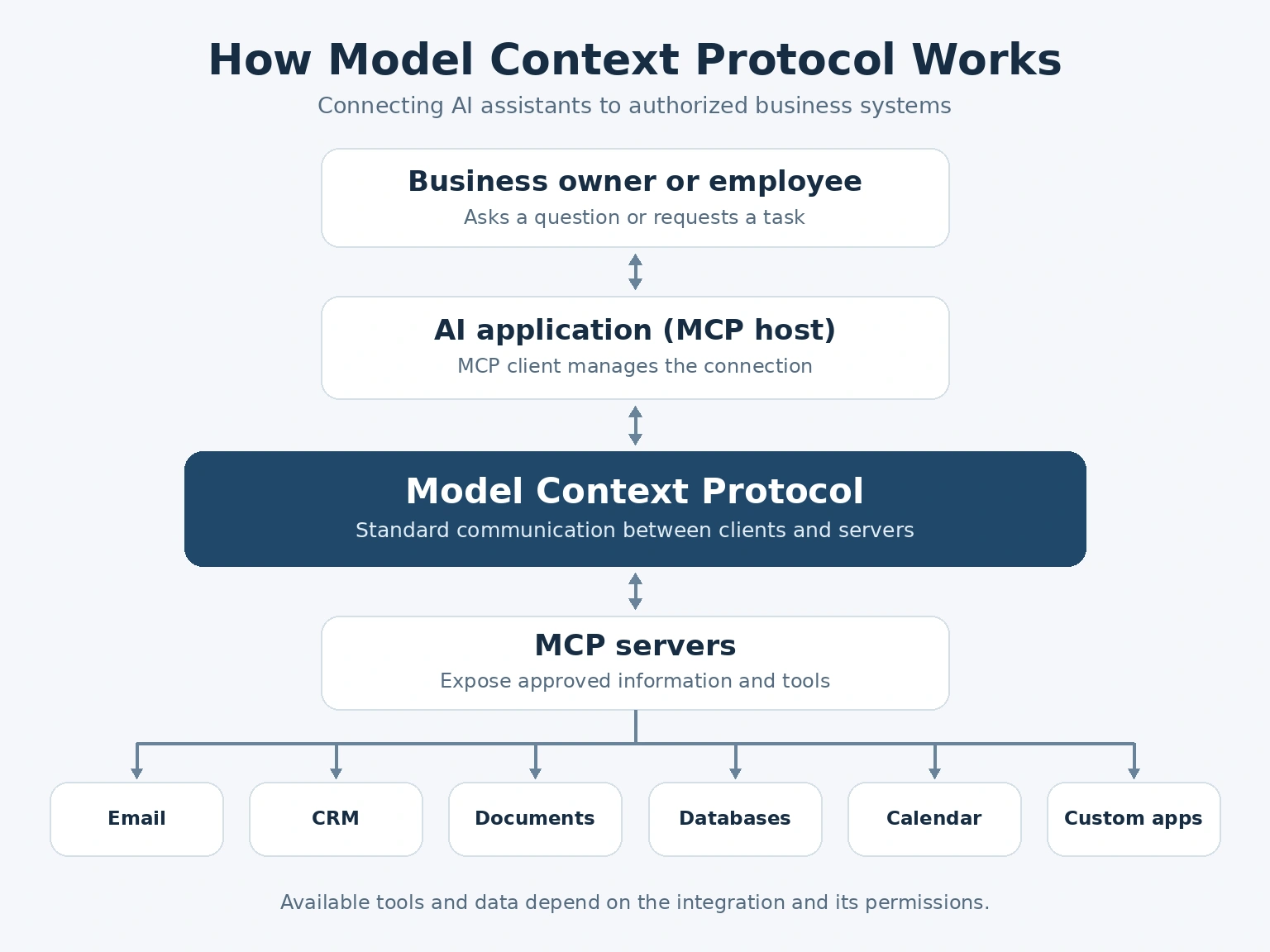
There are three primary components involved in an MCP connection.
The MCP host
The host is the application through which you interact with AI, such as a compatible AI assistant.
The MCP client
The client manages communication between the host application and an MCP server.
The MCP server
The server exposes specific information or capabilities from an external system. It determines what services are available to the AI application.
An MCP server might allow an AI assistant to search emails, retrieve customer records, check inventory levels or create project management tasks.
Not every MCP server provides the same capabilities. Some only allow information to be retrieved, while others support creating or modifying records.
The developers and administrators responsible for the connection determine what access is available.
Why is MCP becoming so popular?
One of the biggest limitations businesses face when adopting AI is that their information exists across multiple disconnected systems.
Customer information might reside in a CRM, financial records in accounting software, company documents in cloud storage and project discussions in email.
Without appropriate integrations, employees must gather this information themselves before AI can help them.
MCP addresses part of this challenge by offering a standardized approach to connecting systems.
Major technology companies are already investing in this approach.
Google announced the general availability of its Workspace MCP servers in November 2026. Anthropic has expanded MCP capabilities to support longer tasks and reusable workflow instructions. OpenAI also supports custom MCP connections in eligible ChatGPT business environments.
These developments point toward a future in which AI can become more closely integrated into everyday business operations.
How can businesses use MCP?
The potential applications extend across nearly every industry.
Email and communications
An AI assistant connected to authorized email accounts could summarize conversations, identify unanswered inquiries, locate customer correspondence and prepare suggested responses for review.
Customer relationship management
MCP connections could help employees retrieve customer histories, research sales opportunities, prepare for meetings and organize information within a CRM.
Project management
Business owners could ask AI to summarize project progress, identify overdue tasks and prepare status reports using information from their existing project management software.
Employee training
An internal AI assistant could retrieve information from company training materials, operating procedures and product documentation, helping employees find answers without interrupting managers.
Ecommerce and inventory
Retailers could use connected AI applications to review product information, summarize sales activity, identify inventory concerns and answer operational questions.
Custom business applications
Companies using proprietary software or databases could develop MCP servers that expose selected capabilities to compatible AI applications.
This is particularly valuable for businesses whose existing software does not offer native AI integration.
What are the benefits of MCP for small businesses?
- Reduced administrative work: Spend less time gathering information and transferring data between applications.
- Connected business systems: Help existing software work together without unnecessarily replacing it.
- Better decision making: Retrieve and analyze relevant business information more efficiently.
- Defined access: Design integrations around specific permissions and business requirements.
- Greater flexibility: Potentially reuse integrations across compatible AI platforms.
- Room for growth: Expand AI capabilities as your business needs evolve.
The real benefit of MCP is not simply connecting software to artificial intelligence. It is what your business can accomplish once those connections are established.
For more guidance, read Where Will AI Create Measurable Business Value First in Our Company?
MCP versus traditional APIs
Businesses have used application programming interfaces, or APIs, to connect software for many years.
MCP does not necessarily replace those APIs. In many implementations, an MCP server uses existing APIs behind the scenes.
| Traditional APIs | MCP |
|---|---|
| Connect software applications | Connect compatible AI applications to external capabilities |
| Require application specific integration logic | Provide a common communication standard |
| Expose data and software functions | Describe available tools, resources and other capabilities |
| Support traditional software development | Support AI assistants and agent workflows |
Traditional APIs will continue to play an important role in software development. MCP provides an additional layer designed around how AI applications interact with external systems.
How do you get your own MCP connection?
There are several approaches, depending on your business requirements.
1. Use an existing MCP integration
Some software providers offer MCP servers or integrations that can be connected to compatible AI applications.
If the integration already supports what your business needs, this may be the simplest and most affordable option.
2. Use a hosted MCP service
Hosted services can provide managed connections between AI applications and business software without requiring your company to maintain its own server.
These services may involve subscription fees, usage charges or other limitations.
3. Develop a custom MCP server
A custom MCP server is often worth considering when your business uses specialized software, internal databases, proprietary applications or workflows not supported by existing integrations.
A custom server can be designed around the specific information and capabilities your business needs.
For example, I recently developed an MCP connection that allows compatible AI assistants to retrieve information from my business email accounts. Rather than manually searching multiple mailboxes, I can ask AI to help locate correspondence and summarize relevant information.
A similar solution could be developed around your company’s software and operational requirements.
4. Work with an AI integration consultant
An experienced consultant can help you evaluate existing solutions, determine whether custom development is necessary, establish permissions and integrate MCP into your business processes.
The goal should be to choose the right solution, not automatically build the most complicated one.
For more information, read What You Must Evaluate Before Building an AI Strategy for Your Business.
Is MCP secure?
MCP can support controlled access to business systems, but security depends on how the integration is designed, configured and maintained.
Before connecting AI to company information, business owners should establish:
- Which information AI is permitted to access.
- Which applications and employees are authorized to use the connection.
- Whether AI can modify records or only retrieve information.
- Which actions require employee approval.
- How sensitive company and customer information is protected.
- How access and activity are monitored.
Connecting AI to sensitive business systems should never be treated as a simple software installation.
Start with limited access, test the results and expand capabilities only when appropriate.
How I can help your business implement MCP

With more than 25 years of experience supporting businesses through technology consulting, software development and system integration, I understand that every organization has different operational requirements.
My approach focuses on identifying where MCP and AI integration can deliver practical business value.
See my MCP consulting and custom AI integration services for how a project runs and what it costs.
AI readiness and opportunity assessment
I evaluate your current software, workflows and business objectives to identify where AI integration makes sense.
MCP consulting and integration planning
I help determine which existing MCP solutions meet your requirements and where additional development may be necessary.
Custom MCP server development
I can design and develop custom integrations for internal applications, databases and business systems that do not already provide suitable AI connections.
Business process automation
I help develop connected workflows that reduce repetitive tasks, improve information access and support employee productivity.
Implementation, training and support
I can assist with deploying, testing and maintaining integrations while helping your employees understand how to use them effectively.
Not every business needs a custom MCP server. Part of my job is helping you understand when an existing solution is sufficient and when a more customized approach will deliver greater value.
Commonly Asked Questions
Do I need programming experience to use MCP?
No. Existing integrations may require little technical knowledge to connect and use. Custom MCP development generally requires software development experience.
Can MCP connect to ChatGPT and Claude?
Yes. Both platforms support MCP capabilities, although availability, features and administrative requirements vary by subscription and platform.
Is MCP free?
MCP is an open standard. However, AI subscriptions, commercial integrations, hosting, development and ongoing maintenance may involve costs.
Can MCP connect to my company’s database?
Yes. An appropriately designed MCP server can provide authorized access to selected database information and capabilities.
Do I need to replace my existing business software?
Usually not. One of the advantages of MCP is its potential to integrate AI with the systems your company already uses.
Can MCP automate business processes?
MCP can help AI access tools needed to support automated workflows. The actual automation depends on the connected software, available capabilities, business rules and permissions.
Does every business need an MCP server?
No. Many businesses can benefit from existing integrations without developing their own server. Start by identifying what you want to accomplish.
Connect AI to the way your business works
The future of artificial intelligence is not limited to more powerful chatbots.
It increasingly involves connecting AI to the information, software and processes that businesses depend on every day.
MCP provides an important opportunity to make those connections possible.
The question is not simply whether your business can use MCP. It is where connected AI systems could create measurable improvements within your organization.
If you are interested in exploring how MCP, AI integration or custom automation could benefit your business, I can help you identify the right place to start.
Request your free AI Readiness Assessment or contact me to discuss your business requirements.