
What Digital Transformation Actually Means
I want to be direct with you about something: digital transformation is one of the most misunderstood phrases in business today.
It is not a website redesign. It is not buying new software. It is not automation alone, and it is definitely not a one-time project you finish and move on from. Digital transformation is a structured evolution of how your business operates, from the inside out.
At its core, transformation means aligning your processes, your data, and your systems so they work together to improve four things: speed, accuracy, scalability, and visibility. When those four things improve, your business gains real operational leverage. You can do more with the same team. You can spot problems before they become expensive. You can grow without hiring at the same rate.
Think of it this way. Most small businesses grow organically, adding tools and people as problems appear. That works for a while. But at some point, the patchwork stops holding together. Information lives in too many places. Work gets repeated. No one is sure which version of a document is current. That friction is not a people problem. It is a structural one, and digital transformation is how you fix the structure.
This is operational architecture. Not technology hype.

Why Most Transformations Stall
Here is the hard truth. Most digital transformation efforts fail. Not because the technology is bad, but because the business was not ready for it.
I have seen this pattern repeat across organizations of all sizes. Leadership commits to a transformation initiative, picks a platform, rolls it out, and then wonders why adoption is low and results are disappointing. The answer is almost always one of five things.
The first is leadership misalignment. When executives and team leads have different definitions of success, every decision becomes a negotiation. Progress slows to a crawl.
The second is undefined processes. You cannot automate a process that nobody has documented. If your team handles similar tasks three different ways depending on who is working that day, automation will simply make the inconsistency faster.
The third is poor data structure. Dirty, inconsistent, or siloed data is the silent killer of transformation projects. You can buy the most powerful analytics tool on the market, but if the data feeding it is unreliable, the insights will be unreliable too.
The fourth is tool-first thinking. This one is extremely common. A business leader sees a compelling product demo, buys the software, and then tries to fit the business around it. That is backwards. Tools should serve your process, not define it.
The fifth is cultural resistance. People resist change when they do not understand why it is happening or how it benefits them. That is not stubbornness. That is human nature. Transformation without a communication strategy is transformation without adoption.
Technology exposes weaknesses. It does not automatically fix them. Before you invest in any new system, you need to honestly assess where your operations stand today.
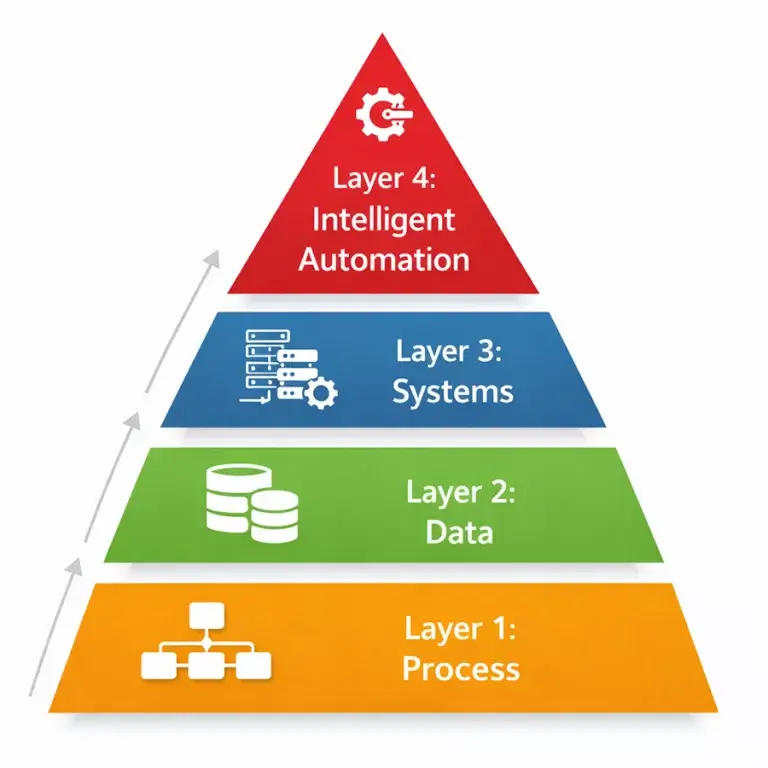
The Four-Layer Model for Effective Transformation
Effective transformation is not random. It follows a deliberate sequence. I call this the Four-Layer Model, and once you understand it, you will never look at a technology decision the same way again.
Layer 1: Process
Process is the foundation. Before you touch any technology, you need to define how work should flow. What triggers a task? Who handles it? What does a successful completion look like? What happens when something goes wrong?
This sounds basic, but most small businesses have never mapped this out. They operate on shared intuition built up over the years. That intuition is valuable, but it is also invisible, which means it cannot be optimized, handed off, or scaled.
Start by documenting your highest-volume workflows: client onboarding, invoicing, project handoffs, and customer follow-ups. Write them down in plain language. You will immediately spot the redundancies, the gaps, and the bottlenecks.
Layer 2: Data
Once your processes are defined, you need to standardize what information gets captured and how. This is not just about choosing a CRM or a database. It is about deciding what data matters, in what format it should live, and who is responsible for keeping it accurate.
A common mistake is letting every team member capture data in whatever format feels natural to them. One person writes client names as “First Last,” another writes “Last, First,” and a third does not bother at all. Multiply that across months and hundreds of records, and you have a data quality problem that no software can solve for you.
Clean, standardized data is what makes everything downstream possible, from reporting to automation to AI.
Layer 3: Systems
With your processes documented and your data structure defined, you can now make intelligent decisions about systems. You are no longer buying software based on a demo or a colleague’s recommendation. You are selecting tools that support your specific process and data requirements.
This changes everything about vendor evaluation. Instead of asking “what does this tool do,” you ask “does this tool support how we work and how we need our data to flow?” That is a much more powerful question, and it will save you enormous amounts of money and frustration.
Layer 4: Intelligent Automation
Automation and AI belong at the top of the model, not the bottom. This is the layer where the most excitement happens, and unfortunately, where most businesses try to start.
When you apply automation to a stable process with clean data and a well-chosen system, the results are powerful. You free your team from repetitive work. You reduce errors. You speed up cycle times. You generate better data, which leads to better decisions.
When you apply automation to an unstable process with messy data and a mismatched system, you get faster chaos. The technology works exactly as designed. The problem is that what it was designed to do no longer matches what your business actually needs.
Skipping layers leads to frustration. Building them in order leads to results.

Budgeting and Phasing Your Transformation
One of the questions I hear most often is “How much should this cost, and how long will it take?” The honest answer is that it depends on your starting point. But transformation should always be phased, and each phase should build on the capability established before it.
Phase 1 is about clarity and standardization. Your job in this phase is to document your core workflows and eliminate variation. You are not buying anything new yet. You are getting your house in order. This phase costs relatively little in money but requires genuine attention from leadership.
Phase 2 is about data. You clean what you have, establish standards going forward, and centralize information into fewer, better-managed places. This is often when businesses realize just how fragmented their data has become. That discovery is uncomfortable, but it is also where the real value of transformation begins to appear.
Phase 3 is about integration. You select and implement systems that connect your processes and your data. This is typically the most expensive phase in terms of direct investment, and it is where change management becomes critical. Your team needs training, context, and clear communication about why things are changing.
Phase 4 is where automation and optimization live. With stable processes, clean data, and well-integrated systems, you can now apply intelligent automation, AI tools, and continuous improvement cycles. This phase does not end. It compounds over time, which is exactly the point.
Each phase builds capability that the next phase depends on. Skipping ahead is tempting, especially when a new tool looks compelling. Resist that temptation. The businesses that do this in order are the ones that actually reach Phase 4 with something worth automating.

Measuring ROI Without Guessing
One of the biggest reasons transformation projects lose leadership support is that nobody defined success upfront. By the time someone asks, “Is this working?” nobody can agree on what “working” means.
The good news is that transformation is completely measurable when you define your metrics before you start.
Reduced manual hours is the most immediate and tangible metric. Before implementation, document how long each specific task takes. After implementation, measure the same tasks. The difference is your time savings, and time has a real dollar value. Research from Salesforce found that 56% of companies using AI to optimize day-to-day operations report saving roughly 30% of their time. For a small team, that is a transformative number.
Faster cycle times measure how quickly you move from start to completion on key workflows: client onboarding, proposal delivery, and invoice processing. If you cut your onboarding time from five days to two, that has a direct impact on client satisfaction and on cash flow.
Error reduction is often underestimated. Manual processes carry a natural error rate, and errors are expensive. They create rework, damage client relationships, and sometimes carry financial penalties. Measuring your pre-transformation error rate and tracking improvement are among the clearest ways to demonstrate real ROI.
Increased margin reflects the combined effect of efficiency gains across the business. When your people spend less time on low-value work and more time on high-value work, margin follows.
Revenue velocity measures how quickly your business can close, deliver, and recognize revenue. A faster, more automated sales and delivery process allows you to handle more volume without proportional headcount-growth.
The key is to establish your baseline before you start Phase 1. Document your current state in each of these areas with real numbers. Then revisit those numbers at the end of each phase. You will have a clear, defensible story of what transformation has actually delivered.

Strategy Matters More Than Tools
I want to close with the point I think matters most. Small businesses attempting digital transformation without strategic oversight almost always hit the same wall. They make early progress, encounter friction, and then stall. Not because the idea was wrong, but because the implementation was not connected to a larger plan.
A structured strategy reduces risk. It improves adoption. It makes every technology decision easier because you have a framework to evaluate it against. And when transformation is aligned with a five-year business roadmap, AI becomes a natural next step rather than a gamble.
Think about what your business needs to look like in five years. How many clients? What revenue? What team size? What markets? Now work backwards. What operational capabilities does that future version of your business require? What data does it depend on? What systems need to be in place?
That backwards-working exercise is the foundation of a real digital transformation strategy. It tells you not just what to build, but why, and in what order.
I have worked with small business leaders who tried to do this alone and those who brought in strategic support from the start. The ones who invested in structured guidance consistently moved faster, spent less on course corrections, and reached Phase 4 with confidence rather than exhaustion.
Digital transformation is not a luxury for large enterprises. It is a competitive necessity for every serious small business leader. The right time to start building the foundation is always now, before the pressure forces you to skip layers.