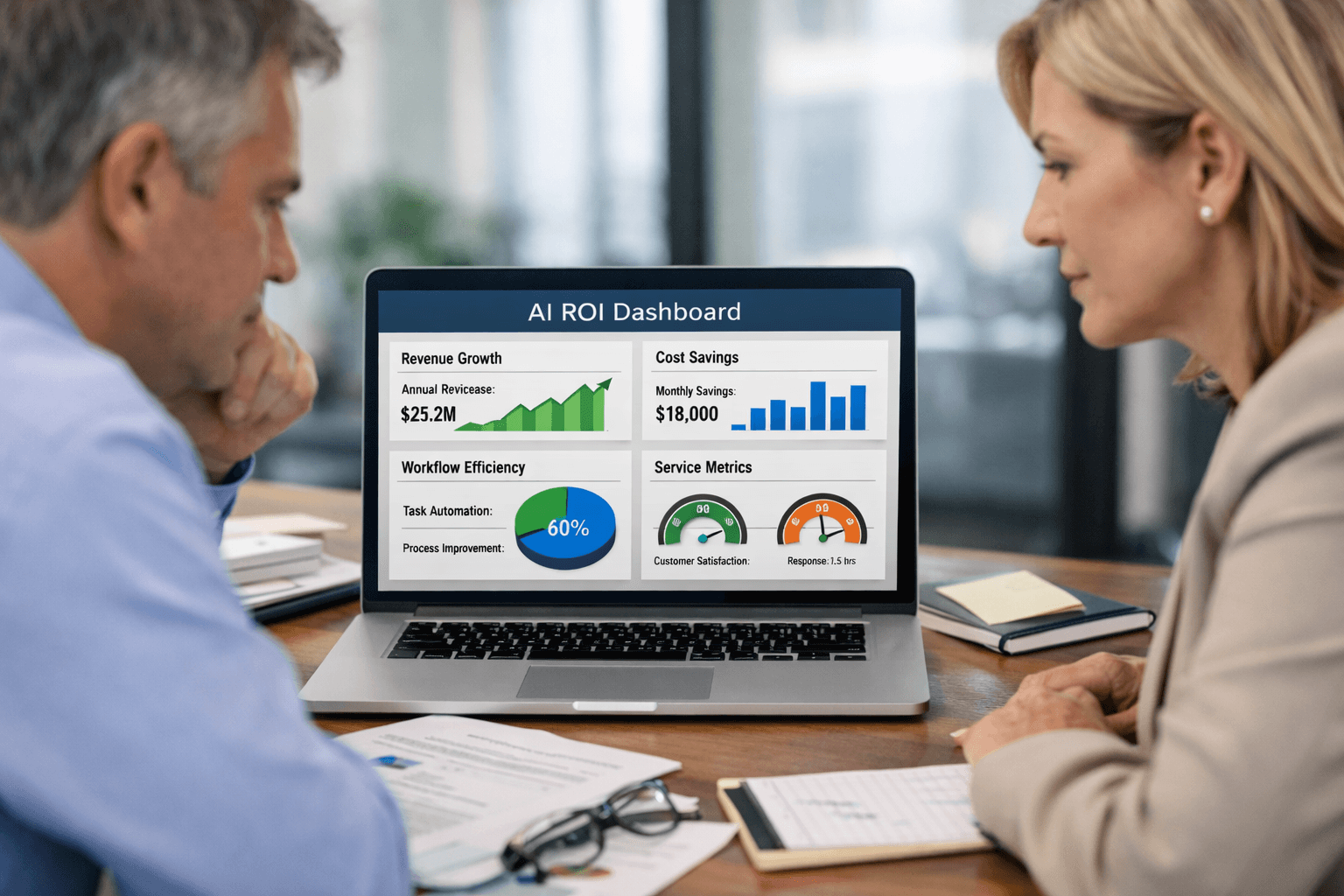
For a few years, AI has been surrounded by big promises. Smarter workflows. Lower costs. Faster growth. Better customer experiences.
Now the conversation is changing.
In 2026, more business leaders are asking a simpler question: where is AI actually making money?
That is the right question. AI is no longer impressive just because it exists. It has to prove itself in revenue, efficiency, margin improvement, service quality, speed, and operational visibility. That shift matters because AI adoption is now broad, but real financial impact is still uneven.
AI can absolutely create value. But it does not create value everywhere, and it does not create value automatically. The businesses seeing results are usually doing something more disciplined than just buying tools. They are redesigning workflows, choosing narrow use cases with clear business value, setting measurable goals, and building the human oversight needed to make AI reliable.
If you have been thinking about AI strategy and readiness for small businesses, this is where the conversation becomes practical. The question is no longer whether AI matters. The question is where it is worth your time, money, and effort.

The use cases producing the clearest ROI
1. Customer service and support operations
This is one of the most practical places to start.
AI is delivering value in customer service because the economics are straightforward. Businesses can reduce response times, improve self-service, assist support staff during live interactions, and handle higher ticket volume without growing headcount at the same pace.
This works especially well when AI is used to:
- Draft responses for agents
- Summarize tickets and prior interactions
- Classify requests and route them correctly
- Power well-structured self-service experiences
- Surface knowledge base answers in real time
The return usually comes from a mix of lower service costs and better customer experience. In many businesses, that is more valuable than flashy experimentation because it affects daily operations right away.
2. Marketing and sales enablement
AI is also showing clear value in marketing and sales, especially when it helps teams move faster and make better decisions rather than simply produce more content.
The strongest use cases here tend to include:
- Sales email and proposal support
- Lead qualification and prioritization
- Campaign analysis and optimization
- Content production with human review
- Faster segmentation and personalization
- Summarizing call notes and extracting follow-up actions
The key is that AI works best when it improves the output of existing revenue teams. It tends to underperform when companies expect it to replace strategy, messaging, or relationship-building.
If you want a narrower starting point, my article on 5 high-impact, low-cost AI use cases for business covers the kinds of focused applications that often lead to early wins.
3. Internal operations and workflow automation
This is where many small and mid-sized businesses can find fast wins.
AI can reduce the drag caused by repetitive admin work, disconnected tools, duplicate entry, inconsistent documentation, and manual reporting. That is not glamorous, but it is often where the money is. Businesses save time, reduce errors, and free up staff to focus on more valuable work.
Common high-value operational use cases include:
- Meeting summaries and action extraction
- Document classification
- Contract or form review assistance
- Internal knowledge search
- Report drafting
- Inbox triage
- Scheduling and follow-up workflows
- Pulling insights from fragmented business systems
For many companies, this is the real starting point because it creates visible operational gains without requiring a complete transformation project.
That is also why software sprawl is draining your business is such an important issue to address before or during AI adoption. If your systems are fragmented, AI will expose those weaknesses quickly.
4. Software development and technical productivity
AI is making a measurable impact in software and technical work, but the results are more nuanced than some headlines suggest.
In many teams, AI helps with drafting code, writing tests, documenting functions, explaining legacy systems, and accelerating repetitive development tasks.
That said, the money here does not come from handing technical judgment over to a tool. It comes from faster delivery, reduced bottlenecks, quicker maintenance cycles, and better use of skilled technical talent.
AI helps technical teams most when:
- Code review still exists
- Standards are clear
- Technical debt is managed
- Teams know when not to trust the output
- The goal is acceleration, not blind automation
5. Decision support and business visibility
This may become one of the most valuable long-term categories.
AI can help leaders understand what is happening inside the business faster by summarizing data, highlighting trends, surfacing anomalies, and making large amounts of operational information easier to interpret.
This is important because many businesses do not have an AI problem first. They have a visibility problem.
If leaders cannot quickly see:
- Where work is getting stuck
- Which channels drive profit
- What customers are asking for
- Which processes waste time
- Where sales are slowing
- What service issues are recurring
Then AI can help, but only if it is connected to useful data and tied to decisions that actually matter.
The pattern is consistent: AI creates the strongest ROI when it improves an existing business outcome that already matters, such as response time, cost per task, turnaround speed, lead follow-up, or service consistency.

Where AI still falls short
This is the other side of the story, and it is just as important.
AI does not automatically create ROI. In many businesses, it still underperforms for a few common reasons.
1. Tool-first adoption
A lot of organizations still begin with the tool instead of the business problem.
They buy a chatbot, writing assistant, or automation platform before deciding what result they are trying to improve. That often leads to scattered pilots, unclear ownership, weak adoption, and vague outcomes.
2. No workflow redesign
If a broken process gets AI added to it, it often just becomes a faster broken process.
This is one of the biggest reasons AI projects stall. Without changing how people work, how decisions get made, and how information moves through the business, the gains stay small and isolated.
If that sounds familiar, start by mapping how work actually flows today. My article on mapping your current workflow is a useful starting point.
3. Weak data and disconnected systems
AI can summarize, classify, and generate. But if the underlying business data is messy, incomplete, siloed, or inconsistent, the output will be limited.
This is especially common in businesses dealing with too many apps, inconsistent CRM usage, poor documentation, or multiple versions of the same information spread across email, spreadsheets, and internal files.
4. No measurement discipline
A surprising number of businesses still cannot clearly answer:
- What success looks like
- What baseline they are measuring against
- How cost is being tracked
- Who owns the outcome
That is why essential metrics for measuring workflow efficiency matter so much. Without a baseline, it is hard to prove that AI is making anything better.
5. Too little human oversight
AI still makes mistakes. That is why it works best when people review outputs, validate important decisions, and stay accountable for quality.
This is especially important in areas like proposals, contracts, customer communication, forecasting, and reporting. AI can help speed up the work, but it should not become the final authority.

What separates AI that pays off from AI that disappoints
The businesses seeing the strongest returns from AI are usually doing five things well.
They start with a business problem
Not “Where can we use AI?” but “Where are we losing time, money, visibility, or momentum?”
They choose measurable use cases
The best AI initiatives usually connect to a simple before-and-after business metric, such as response time, conversion rate, cost per task, average handling time, time to produce a deliverable, error rate, turnaround speed, or margin improvement.
They redesign the workflow
They do not just drop AI into the old process and hope. They look at how work moves through the business and improve the system around the tool.
They keep humans in the loop
They treat AI as support, not as unsupervised authority.
They scale what works
They avoid endless pilots and invest further in the use cases that show real value.
This is where AI orchestration becomes important. Real business impact usually comes from connecting tools, people, data, and workflows in a way that actually supports the business instead of adding more complexity.
The real ROI question businesses should ask in 2026
The best question is not whether AI works.
It does.
The better question is this:
Where can AI improve a business outcome that already matters?
That might be:
- Helping your team close work faster
- Reducing repetitive admin load
- Improving service consistency
- Increasing marketing output without lowering quality
- Making sales follow-up more consistent
- Reducing delays caused by fragmented information
- Helping leadership make faster, better decisions
That is where ROI becomes real.
Because in 2026, AI is no longer a novelty project. It is becoming an operational tool. The companies getting the most from it are not treating it like magic. They are treating it like infrastructure.
And that is usually when the money shows up.
Final thought
AI can absolutely create revenue growth, cost savings, and better efficiency. But the biggest returns are not coming from random experimentation. They are coming from focused use cases, cleaner workflows, better measurement, and stronger business discipline.
If you want AI to make money, start where the friction already is.
That is usually where the return is hiding.