What Does AI Actually Mean for a Service Based Business?
When people search for how service businesses can use AI, they are not asking about robots or complex data science. They want to know how to reduce chaos and improve profit.
In a service company, artificial intelligence means using intelligent software to automate repetitive tasks, improve scheduling, enhance customer communication, and generate insights from operational data.
At a practical level, that looks like:
- Automating administrative work
- Improving response times
- Reducing human error
- Increasing operational visibility
If you run a home service company, an agency, or a professional services firm, AI is not a trend. It’s an operational tool.
According to the McKinsey 2025 State of AI report, more than 67 percent of organizations are using AI in at least one business function.
The companies seeing results are not experimenting randomly. They are applying AI where time and margin are leaking.
That is where strategy begins.

Can Small Service Businesses Use AI?
Yes.
AI for small service businesses does not require a data science team or custom software development.
Most AI implementation for service companies today happens inside tools you already use:
- Cloud-based scheduling platforms
- CRM systems with built-in AI
- AI assistants that summarize calls and meetings
- Workflow automation platforms
If you are asking how to implement AI in a service business, the real question is whether your processes are documented.
Small companies often gain faster ROI than large enterprises because decisions move quickly.
I have worked with service businesses that reduced manual reporting time by 40 percent simply by automating data extraction from their CRM into a clean dashboard. No new hire. No new department.
Where AI Creates the Most Value in Service Companies
If you are researching AI automation for service businesses, focus on high-friction areas first.
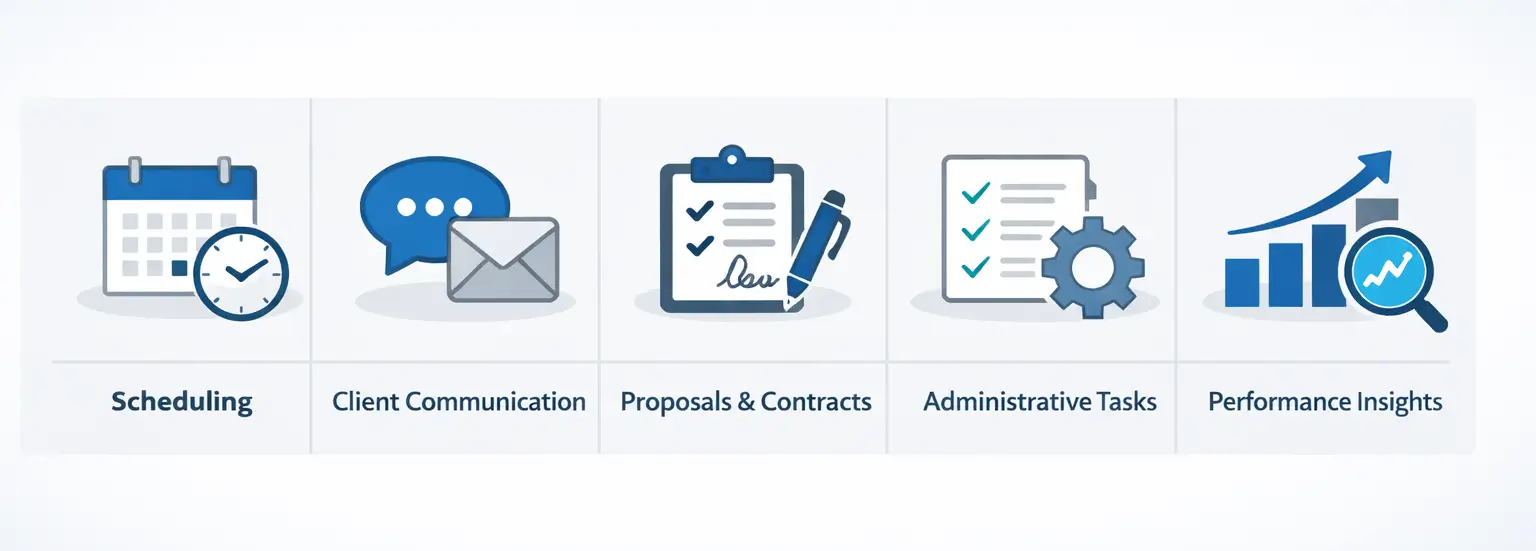
Scheduling and Dispatch -AI for service scheduling and dispatch management can optimize routes, reduce travel time, and prevent double-booking. For contractors and home service companies, this directly increases billable hours.
Client Communication – AI for customer service automation handles appointment reminders, follow-ups, and basic inquiries. Faster response times increase close rates.
Estimating and Proposals – AI for estimating and quoting services can draft proposals based on predefined pricing logic. That reduces turnaround time and improves consistency.
Administrative Work – Invoice generation, data entry, and recurring reporting can be automated. AI workflow automation for small businesses often starts here.
Business Insights – AI can analyze trends in job types, margins, and response times. This improves decision-making.
According to Salesforce research, high-performing service teams are 2 times more likely to use AI.
AI for local service businesses is about efficiency, not experimentation.

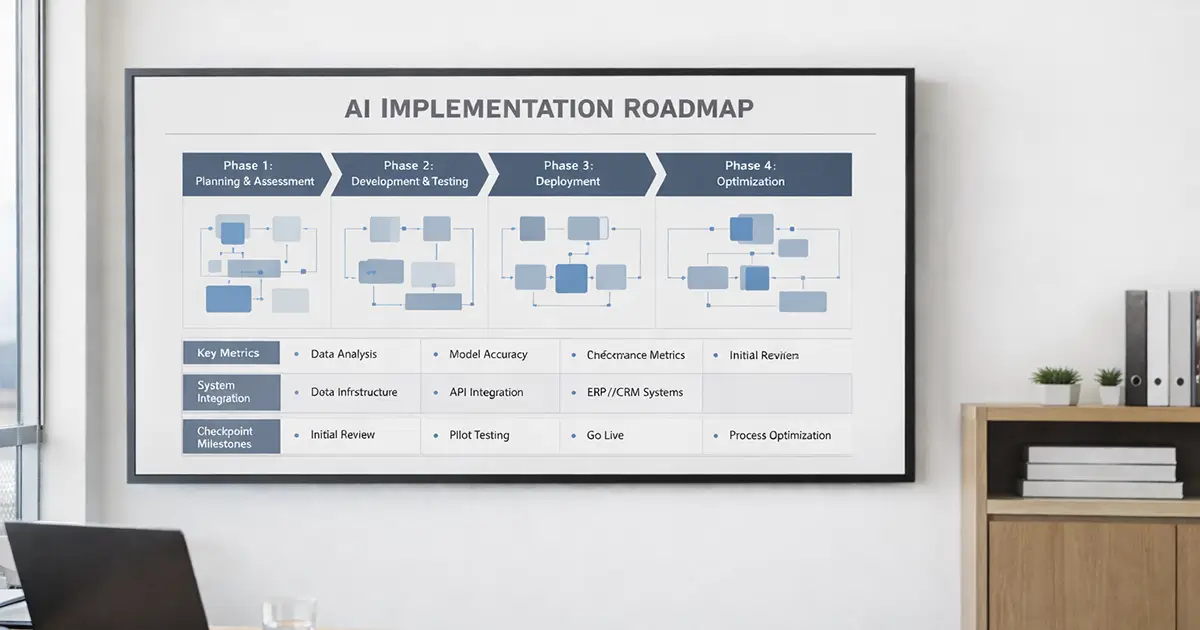
How to Implement AI in a Service Business Step by Step
If you are serious about AI strategy for service businesses, follow a disciplined approach.
- Document one core workflow
- Identify repetitive tasks
- Calculate time and cost impact
- Evaluate AI tools for your business based on integration and fit
- Pilot before full rollout
- Measure AI ROI for service businesses over 90 days
Most failures happen at step one. If your workflow design is unclear, automation multiplies confusion.
Most AI failures do not happen because the software is weak. They happen because the underlying workflow was never clearly defined.
If your team handles scheduling three different ways, or if proposals depend on who happens to write them, automation will not fix that. It will scale the inconsistency. The system will move faster, but in the wrong direction.
Common Mistakes to Avoid When Adopting AI
Many owners buy software before defining outcomes.
Avoid these common errors:
- Buying tools without workflow clarity
- Automating broken processes
- Ignoring integration requirements
- Expecting instant ROI
- Failing to define ownership
AI consulting for service businesses should begin with business goals, margin targets, and operational bottlenecks. The role of a strategic advisor is to align technology with documented processes and measurable outcomes.
Features do not create profit. Alignment does.
When AI is tied directly to revenue growth, cost reduction, or service capacity, it becomes a lever. When it’s added as a collection of features, it becomes another subscription, creating complexity.
How to Know If Your Service Business Is Ready for AI
You are likely AI-ready if you have:
- Documented workflows
- Defined KPIs
- Clear service margins
- A stable tech stack
- Leadership alignment
AI readiness in a service business is not defined by the software you use. It’s defined by how well your operations are structured, measured, and managed.
If your workflows are documented, your data is reliable, and your leadership team understands where margin is gained or lost, you’re far closer to being AI-ready than a company with the latest tools but no operational clarity.
Technology can accelerate performance, but only when the foundation is steady.
The Difference Between AI Tools and AI Strategy
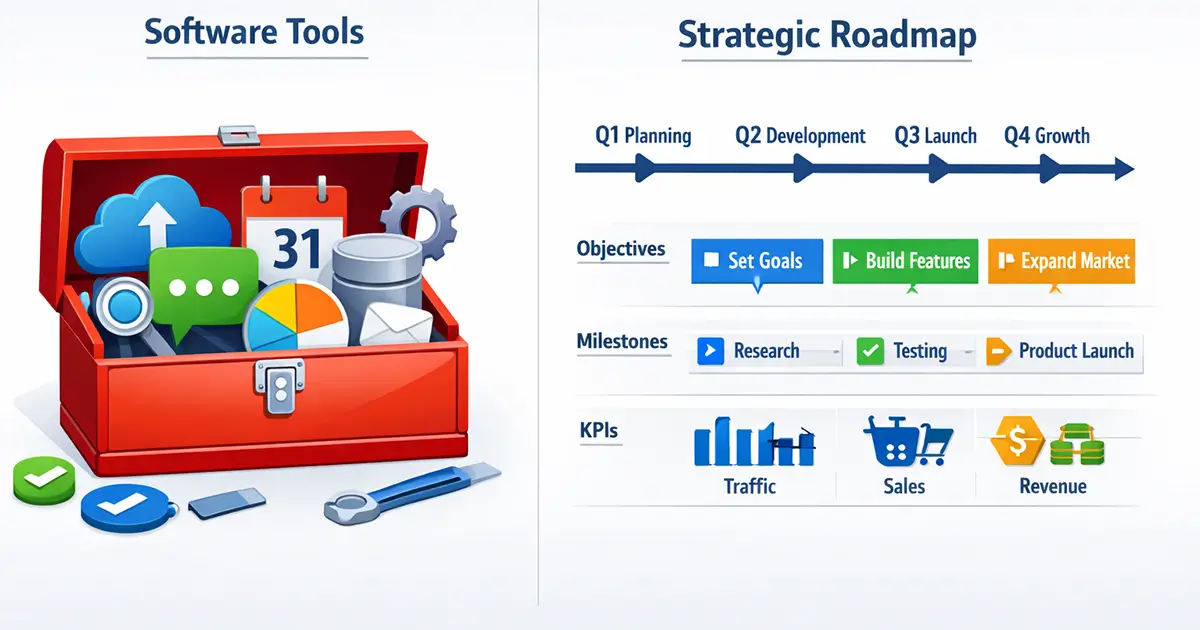
AI tools are features. An AI strategy is an alignment between process, systems, and measurable outcomes.
You can buy a tool in minutes. Building an AI strategy for service businesses requires leadership.
My role is not to resell software. It’s to help you evaluate AI tools for your business, document workflows, design integration logic, and measure ROI.
That is the difference between AI adoption and AI advantage.
Commonly Asked Questions
How can service businesses use AI without large budgets?
You do not need a large budget to start using AI effectively. Many service companies already pay for platforms that include built-in AI features such as automated scheduling, email drafting, call summaries, and reporting tools. The key is knowing where those features fit into your existing workflow.
Start with one clearly defined process, such as client onboarding or estimating. Identify where time is being lost and apply automation there first. Measure the impact before expanding.
If you are unsure where AI can create immediate value in your operations, a short strategic review can often reveal opportunities you are already paying for but not using.
What is the ROI of AI for service businesses?
ROI depends on three primary factors. Time saved, errors reduced, and revenue captured faster.
For example, if AI reduces proposal turnaround time from three days to one, you may close more deals. If automated reminders reduce no shows, you increase billable hours. If reporting becomes automated, leadership regains time for higher-value decisions.
Most small service businesses see measurable improvements within 60 to 90 days when AI is applied to a clearly documented workflow.
The important step is defining what success looks like before implementation. If you would like a structured way to calculate that, I often recommend building a simple 90-day ROI tracking model before committing to a broader rollout.
Is AI only useful for large companies?
No. In many cases, AI for small service businesses is easier to implement than in large enterprises.
Smaller organizations move faster. Decision makers are accessible. Workflow changes require fewer approvals. That flexibility often leads to faster results.
The advantage is not scale. It is clarity and speed.
The question is not whether you are large enough for AI. It is whether your operations are structured enough to benefit from it.
How do I evaluate AI tools for my business?
Start with your process, not the product demo.
Document the workflow you want to improve. Identify the repetitive tasks within it. Estimate the time and cost impact. Then evaluate tools based on integration capability, data flow, total cost of ownership, and measurable outcomes.
If a platform cannot integrate cleanly with your existing systems, it will create friction instead of efficiency.
A disciplined evaluation framework prevents tool sprawl and protects capital. If you want a second perspective before making a significant investment, a structured advisory review can often prevent expensive missteps.
Should I hire an AI consultant?
It depends on your goals.
If you are experimenting with isolated tools, you may not need strategic guidance. If you are aligning AI with operations, growth strategy, and margin improvement, an outside perspective can accelerate clarity.
The right advisor should focus on workflow alignment, measurable outcomes, and integration logic. Not software reselling.
If you are evaluating your next move and want to ensure AI supports your long-term business strategy, a brief strategy conversation can help you make the decision with confidence.