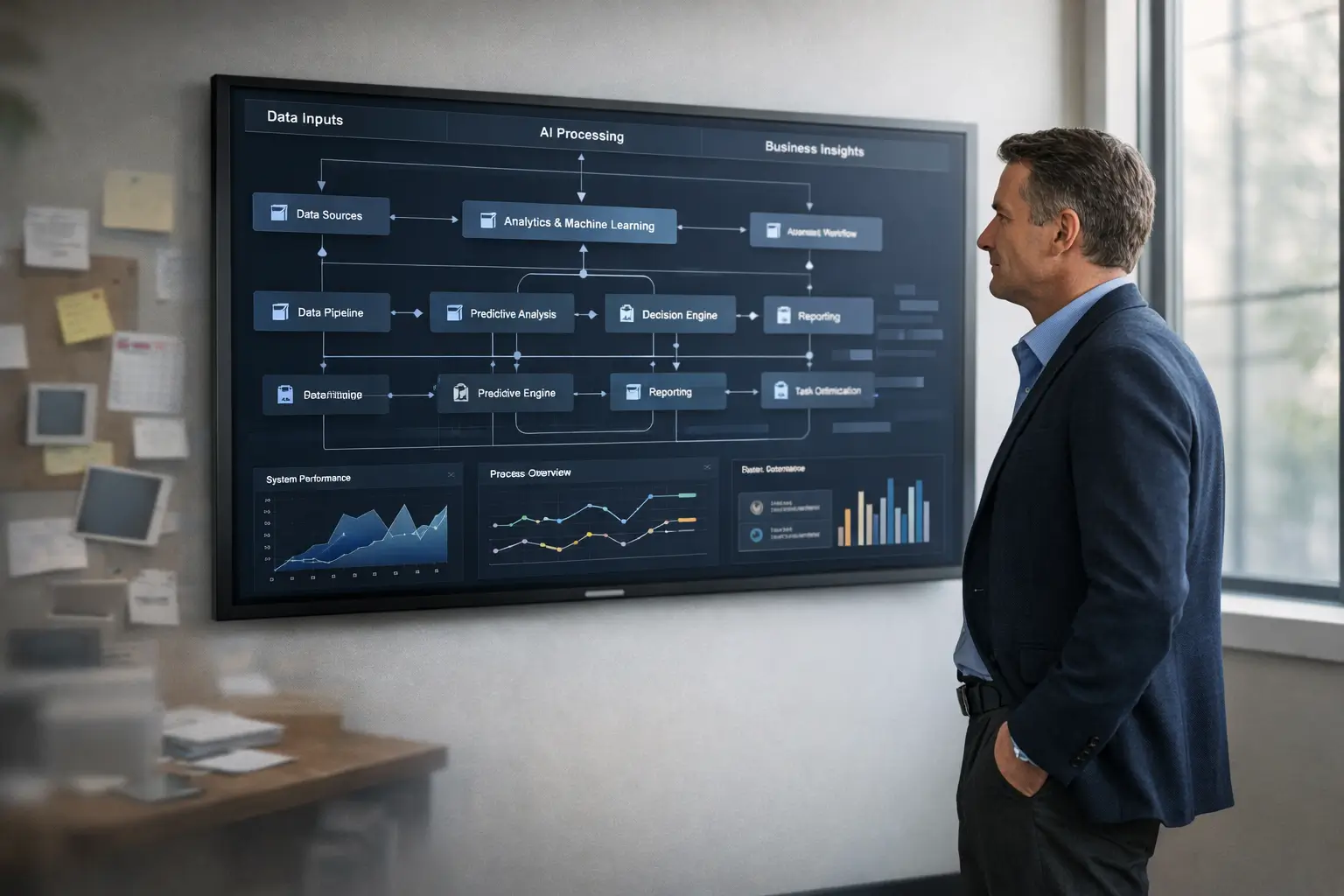
Artificial intelligence is changing roles inside business faster than many leaders expected.
Not long ago, most companies viewed AI as a useful tool. It could help write content, summarize notes, generate images, or answer customer questions. In many cases, it was treated like a productivity add-on. Helpful, interesting, and sometimes impressive, but still optional.
That view is already becoming outdated.
AI is no longer just a collection of standalone tools. It is starting to become part of the underlying operational infrastructure of modern business, much like the internet, cloud computing, email, mobile technology, or data platforms did before it.
This shift matters because it changes the question executives should be asking.
The question is no longer, “Should we try AI?”
The better question is, “Where does AI need to become part of how our business actually runs?”
The Shift From Utility to Infrastructure
A tool is something you pick up when needed.
Infrastructure is something your organization depends on every day, often without thinking about it.
That is the direction AI is moving.
When businesses first adopted the internet, many treated it as a marketing channel. Later, they realized it had become essential infrastructure for communication, commerce, research, operations, and customer engagement.
Cloud computing followed a similar pattern. At first, it was viewed as a technical option. Eventually, it became the foundation for how modern organizations deploy systems, store data, collaborate, and scale.
AI is now following the same path.
In the early stage, businesses experimented with isolated use cases:
- writing assistance
- chatbots
- automated summaries
- image generation
- support for coding or analysis
Those use cases still matter, but they represent the surface level of the change.
The deeper transformation happens when AI begins operating across workflows, systems, decisions, and customer interactions. At that point, it stops being a novelty and starts becoming infrastructure.

What AI Infrastructure Actually Looks Like
When AI becomes infrastructure, it is no longer limited to a single app or department.
It begins to appear across the organization in ways such as:
- routing requests and tasks automatically
- summarizing and classifying internal communications
- extracting information from documents
- assisting customer service across multiple channels
- supporting sales teams with faster research and follow-up
- helping operations teams identify bottlenecks or anomalies
- powering internal knowledge access
- improving forecasting, reporting, and decision support
In this model, AI is not replacing the business. It is becoming part of the operating layer that supports the business.
That distinction is important.
Executives who only see AI as a collection of point solutions may underinvest, adopt it inconsistently, or allow it to spread chaotically without governance.
Executives who recognize it as infrastructure begin thinking differently. They start asking:
- Which workflows should AI support by default?
- Where does human review still matter most?
- What systems need to connect for AI to be useful?
- How should we govern quality, privacy, and accountability?
- What internal processes need to change so AI can create real value?
These are infrastructure questions, not tool questions.
Why This Changes Executive Strategy
Once AI becomes embedded into business operations, it affects much more than productivity.
It begins to shape:
- operating models
- service delivery
- speed of execution
- knowledge management
- cost structure
- customer expectations
- competitive positioning
This means AI strategy cannot remain isolated inside IT or innovation teams.
It becomes a leadership issue.
The organizations gaining the most value from AI are not simply giving employees access to popular tools and hoping for the best. They are thinking more structurally. They are identifying where AI belongs in the business, how it should connect to processes, and how to apply it responsibly.
That is the difference between experimentation and operational maturity.

Should AI Be Integrated Into Every Workflow?
This is the question more executives are starting to ask, and it is the right one, but it needs a careful answer.
Not every workflow needs AI.
But every workflow should probably be evaluated for AI.
That is a very different mindset.
Some workflows are ideal candidates because they involve:
- repetitive administrative work
- document-heavy tasks
- predictable decisions
- large volumes of information
- delays caused by manual routing or review
- customer interactions that follow common patterns
Other workflows may require far more caution because they involve:
- legal or regulatory sensitivity
- high-stakes approvals
- financial risk
- nuanced human judgment
- confidential data
- complex exceptions
The goal is not to force AI into every process.
The goal is to identify where AI can meaningfully improve speed, consistency, visibility, quality, or decision support without introducing unnecessary risk.
That requires business leaders to look at workflows one by one and ask practical questions:
- Where are we losing time?
- Where are people repeating the same work?
- Where are errors happening?
- Where are customers waiting too long?
- Where is information getting stuck?
- Where do employees struggle to find answers?
In many businesses, those questions reveal obvious opportunities for AI integration.
The Risk of Treating AI Too Casually
One of the biggest mistakes companies can make right now is treating AI adoption as informal, fragmented, or purely experimental.
That often leads to:
- teams using different tools with no shared standards
- inconsistent outputs and quality
- security and privacy concerns
- poor integration with business systems
- duplicated effort across departments
- unrealistic expectations about results
In other words, organizations end up with AI activity but not AI capability.
That is why infrastructure thinking matters.
Infrastructure requires planning. It requires standards. It requires ownership. It requires governance. It requires alignment with business goals.
Without that, AI adoption can become messy, expensive, and disappointing.
The Companies That Will Benefit Most
The businesses that will gain the most from AI over the next few years are not necessarily the ones using the flashiest tools.
They are the ones building thoughtful foundations.
That means:
- identifying high-value use cases
- connecting AI to real workflows
- improving data readiness
- defining guardrails
- training teams properly
- measuring outcomes
- refining implementation over time
In other words, the winners will not be the companies that merely use AI.
They will be the companies that operationalize it.
This is the same pattern seen in earlier technology shifts. The biggest advantage rarely went to the company that adopted first. It usually went to the company that integrated best.

What Leaders Should Do Now
For executives, this is the moment to move beyond curiosity and begin structured evaluation.
A practical starting point includes:
- Audit your major workflows
Look for repetitive work, delays, information bottlenecks, and manual handoffs. - Identify high-impact AI opportunities
Focus first on areas where better speed, clarity, and consistency would create measurable business value. - Evaluate your systems and data
AI becomes more useful when it can connect to the information and platforms your business already depends on. - Establish governance early
Set standards for privacy, accuracy, human oversight, and acceptable use before adoption becomes widespread. - Treat AI as part of operations, not just experimentation
Move from isolated testing toward intentional implementation.
This is where many businesses will either gain real momentum or fall behind.
Final Thoughts
AI is moving beyond the category of software tool and into something much bigger.
It is becoming part of the operational foundation of modern organizations.
That does not mean every company needs to automate everything. It does mean leaders should stop viewing AI as a side experiment or optional add-on. The businesses that think this way risk missing the larger shift.
AI is becoming infrastructure.
And once a technology becomes infrastructure, the question is no longer whether it matters.
The question is how intentionally your organization is preparing for it.
Question
If AI becomes as essential to business operations as cloud software or the internet, what workflows in your organization can no longer afford to stay manual?