Aligned with NIST AI Risk Management Framework (AI RMF 1.0)
Executive Purpose
Artificial intelligence introduces operational leverage and risk simultaneously.
This playbook establishes a structured governance model that enables SMBs to deploy AI responsibly, protect sensitive data, maintain accountability, and align AI initiatives with measurable business objectives.
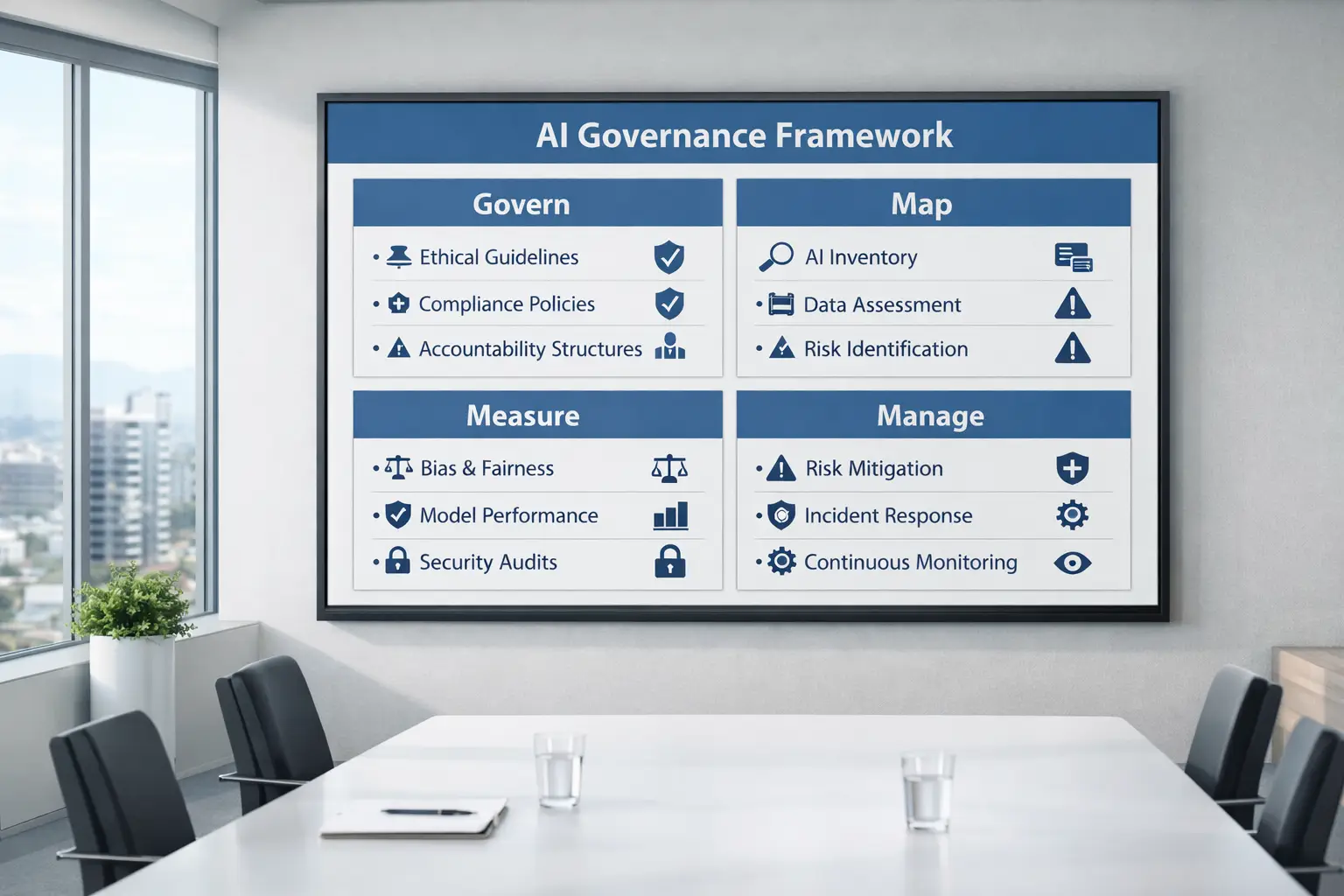
The framework is organized around the four core NIST AI RMF functions:
- Govern
- Map
- Measure
- Manage
1. GOVERN
Organizational Oversight, Accountability, and Policy
This function establishes leadership responsibility and internal controls.
1.1 Leadership Accountability
Define:
- Executive owner of AI initiatives
- Cross-functional AI review group
- Approval authority for new AI tools
- Escalation path for risk issues
AI accountability must be explicit.
1.2 Acceptable Use Policy
Document:
- Approved AI tools
- Prohibited data categories
- Human review requirements
- Output validation expectations
- Data retention standards
All employees should acknowledge AI usage guidelines.
1.3 Risk Classification
Categorize AI use cases:
Low Risk
Marketing drafts, brainstorming, internal summaries
Moderate Risk
Customer communications, proposal generation, and reporting
High Risk
Financial decisions, HR matters, legal content, automated customer decisions
High-risk use cases require additional review and documentation.
1.4 Vendor Governance
Evaluate AI vendors based on:
- Data handling policies
- Model training disclosures
- Security certifications
- Integration capabilities
- Business stability
AI vendors should meet the same standards as financial or IT vendors.
2. MAP
Context, Intended Use, and Impact Assessment
This function defines how AI fits into your environment.
2.1 Business Context Documentation
For each AI initiative:
- Define business objective
- Document affected workflow
- Identify stakeholders
- Clarify decision impact
AI must be anchored to a specific operational context.
2.2 Data Mapping
Identify:
- Data sources used
- Sensitive data categories
- Data flow between systems
- Storage locations
- Third-party access
Understanding data movement reduces unintended exposure.
2.3 Risk Identification
Assess:
- Operational risk
- Reputational risk
- Compliance risk
- Bias and fairness risk
- Automation risk
Document risk exposure before deployment.
3. MEASURE
Performance, Reliability, and Risk Evaluation
AI systems must be evaluated continuously.
3.1 Output Quality Controls
Establish:
- Human review checkpoints
- Accuracy validation procedures
- Benchmark testing for repeat tasks
- Documentation of failure cases
Trust requires verification.
3.2 Performance Metrics
Track:
- Efficiency gains
- Error reduction
- Cost impact
- Revenue influence
- Adoption rate
Measurement ties AI to real business value.
3.3 Bias and Consistency Monitoring
For customer-facing or decision-support systems:
- Review outputs for fairness
- Monitor tone and compliance
- Evaluate consistency over time
Even SMBs should monitor unintended patterns.
4. MANAGE
Ongoing Monitoring and Continuous Improvement
AI governance is not a one-time activity.
4.1 Incident Response Protocol
Define:
- What constitutes an AI incident
- Reporting process
- Containment steps
- Communication plan
Examples include:
- Data exposure
- Inaccurate customer communication
- Biased output
- Incorrect financial summaries
4.2 Change Management
When updating tools or models:
- Reassess risk level
- Revalidate workflows
- Retrain staff if necessary
- Update documentation
Governance evolves with the system.
4.3 Periodic Review
Quarterly review should include:
- Tool inventory
- Risk reassessment
- ROI measurement
- Policy updates
- Vendor review
This prevents drift.
AI Governance Maturity Model for SMBs
Level 1: Informal Use
Ad hoc experimentation, no documentation
Level 2: Policy Awareness
Basic acceptable use guidelines
Level 3: Structured Oversight
Documented workflows and risk classification
Level 4: Integrated Governance
AI tied to KPIs with defined review cycles
Level 5: Strategic Differentiation
AI governance embedded into competitive strategy
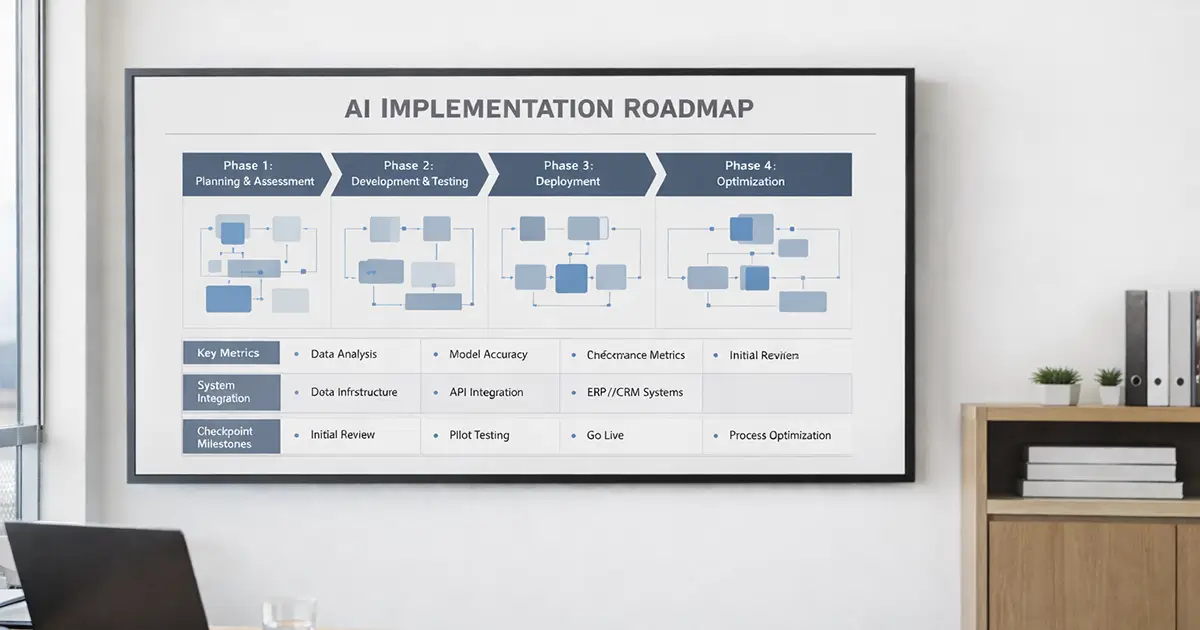
Implementation Roadmap for SMBs
Phase 1
Draft acceptable use policy
Inventory current AI tools
Assign executive owner
Phase 2
Map top three AI use cases
Classify risk levels
Implement review checkpoints
Phase 3
Establish a quarterly AI governance review
Track ROI metrics
Standardize training
Phase 4
Integrate AI performance metrics into strategic planning
AI governance is not about limiting innovation. It’s about protecting the organization while enabling disciplined growth.
SMBs that implement structured oversight early reduce risk, avoid fragmentation, and create sustainable operational advantage.