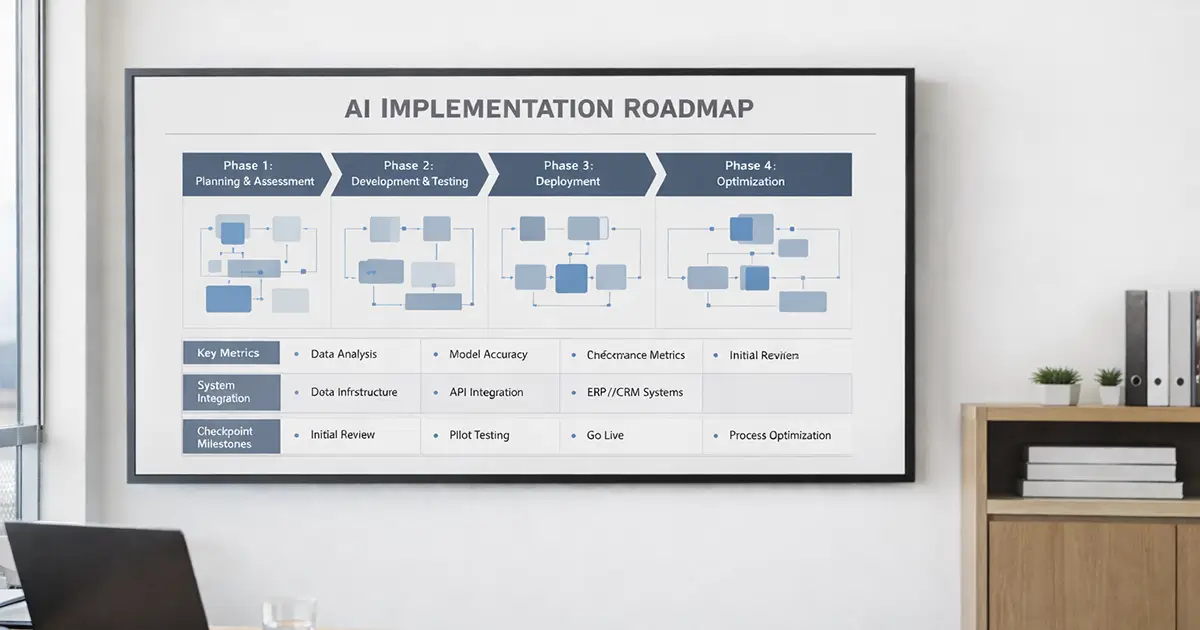
AI does not create an advantage by default. Structure does.
Small and mid-sized businesses that approach AI as a disciplined operational layer, rather than a trend, gain measurable efficiency without exposing themselves to unnecessary risk.
1. Start With a Defined Business Outcome
Do not begin with a tool. Begin with an objective.
Before evaluating any AI solution:
- Define the specific business constraint
- Document the current workflow
- Quantify cost of delay, rework, or inefficiency
- Identify measurable success criteria
If you cannot describe the problem clearly, AI will not solve it clearly.
2. Stabilize the Workflow Before Automating It
AI amplifies structure. It also amplifies disorder.
Before deploying AI:
- Map the process step by step
- Identify ownership at each stage
- Eliminate unnecessary steps
- Standardize inputs and outputs
- Clarify data sources
Automation layered onto broken workflows simply accelerates mistakes.
3. Treat Data as a Strategic Asset
AI effectiveness depends on data quality.
SMB best practices:
- Establish data classification standards
- Avoid entering confidential client or financial data into unsecured tools
- Review vendor data retention and model training policies
- Implement role-based access controls
- Maintain audit logs where possible
Data governance is not optional, even for smaller firms.
4. Keep Human Oversight in Decision Loops
AI should support judgment, not replace it.
Require review checkpoints for:
- Financial decisions
- Legal content
- HR communications
- Customer-facing materials
- Strategic planning outputs
The accountability always remains human.
5. Standardize AI Usage Across the Organization
Unstructured experimentation leads to inconsistent results.
Create:
- Approved use case documentation
- Internal prompt libraries
- Quality review standards
- Brand voice alignment guidelines
- Version control for AI-assisted deliverables
This reduces rework and improves predictability.
6. Measure ROI With Operational Metrics
AI returns compound over time.
Track:
- Hours saved per process
- Reduction in manual rework
- Throughput increases
- Revenue acceleration
- Cost containment
Set realistic expectations:
- Year 1: Learning and alignment
- Year 2: Stabilization and integration
- Year 3: Measurable margin improvement
AI is an efficiency strategy, not a quarterly gimmick.
7. Prevent AI Tool Fragmentation
Many SMBs accumulate AI tools without integration.
Before adopting another tool:
- Confirm functional overlap
- Assess integration capability
- Evaluate the total cost of ownership
- Consider vendor longevity
- Review security posture
Tool consolidation is often more valuable than expansion.
8. Integrate AI Into Core Systems
Data should flow smoothly through all systems
AI delivers value when embedded into:
- CRM workflows
- Accounting processes
- Project management systems
- Marketing automation
- Document management
If outputs require manual transfer between systems, efficiency is limited.
9. Invest in AI Literacy
Technology adoption fails when teams lack clarity.
Provide:
- Use case-based training
- Clear policy documentation
- Data protection education
- Hands-on workflow integration sessions
AI literacy should become part of professional development.
10. Establish Lightweight Governance
Even SMBs need oversight.
Define:
- Who approves new AI tools
- Who owns AI initiatives
- Acceptable data use standards
- Risk review procedures
- Quarterly evaluation checkpoints
Governance early prevents costly course correction later.
11. Manage Change Deliberately
AI adoption introduces cultural friction.
Best practices:
- Communicate intent clearly
- Address job displacement concerns directly
- Reinforce augmentation over replacement
- Pilot before organization-wide rollout
- Capture feedback loops
Adoption is a leadership function, not a technical one.
12. Build Toward Strategic Advantage
AI maturity evolves in stages.
Level 1: Individual experimentation
Level 2: Defined use cases
Level 3: Workflow integration
Level 4: KPI alignment
Level 5: Competitive differentiation
The objective is not AI usage. The objective is operational leverage.